Sample deliverable — differential abundance
"Cell type X increased after treatment" is one of the most commonly reported single-cell findings and one of the easiest to manufacture. Here is the same dataset (GEO GSE96583 (Kang et al. 2018) — 8 donors, control vs IFN-β, 6 h stimulation) analysed both ways.
Do this on your own data: "cell type X went up" is a claim about proportions, and proportions are constrained — which test you use moves the answer as much as the data does. The free QC report shows how many cells per sample you would be testing on, before any compositional test is chosen: omics.hstgenomics.com/qc-check. The same lesson on the expression side of the same cells: omics.hstgenomics.com/sample-pseudobulk.
Want it done rather than shown? We do analysis only — send a count matrix, an h5ad or a Seurat object, Cell Ranger output or a public accession and get the analysis back with the code that produced it, at a fixed price agreed before any work starts: omics.hstgenomics.com/quote.
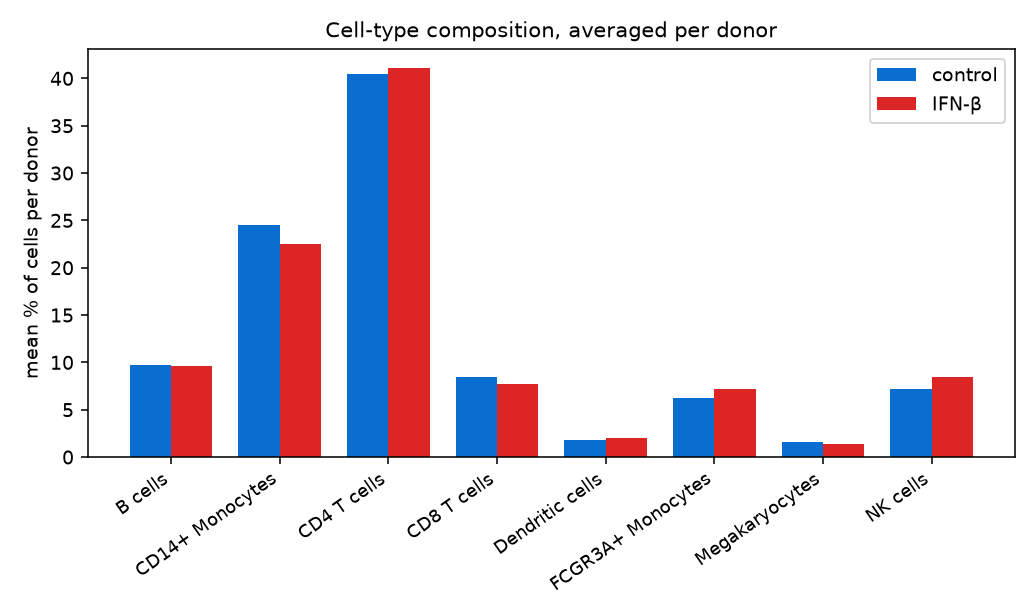
1 · Composition, averaged per donor
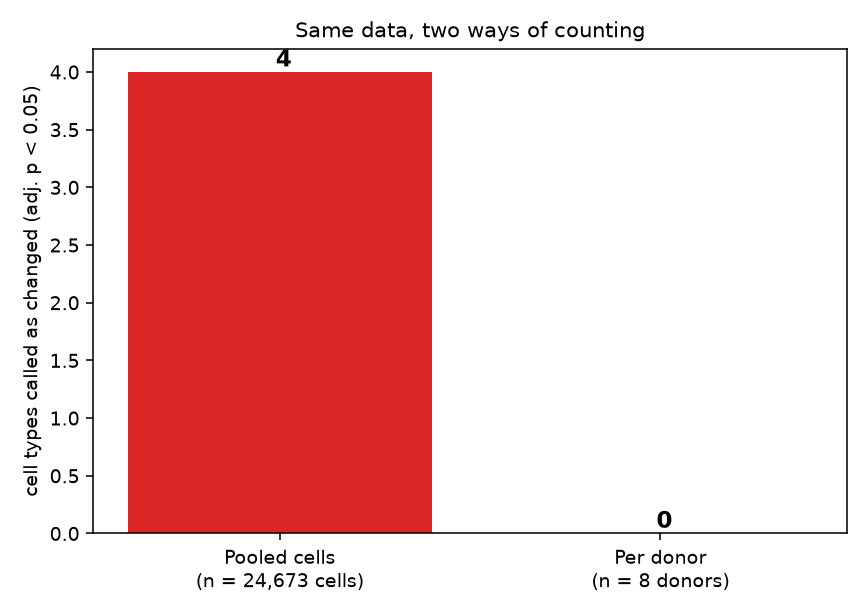
2 · The same data counted two ways
| Cell type | Control | IFN-β | adj. p — pooled cells | adj. p — per donor |
|---|---|---|---|---|
| B cells | 9.73% | 9.66% | 1 | 1 |
| CD14+ Monocytes | 24.54% | 22.53% | 0.023 ✓ | 0.31 |
| CD4 T cells | 40.46% | 41.06% | 1 | 1 |
| CD8 T cells | 8.49% | 7.71% | 0.032 ✓ | 0.12 |
| Dendritic cells | 1.75% | 2.05% | 1 | 1 |
| FCGR3A+ Monocytes | 6.25% | 7.14% | 0.019 ✓ | 0.44 |
| Megakaryocytes | 1.58% | 1.43% | 1 | 1 |
| NK cells | 7.2% | 8.43% | 0.002 ✓ | 0.62 |
Pooling every cell into one contingency table treats 24,673 cells as 24,673 independent observations. At that sample size a difference of one or two percentage points becomes "significant" — which is how 4 cell types end up reported as changed. Testing the same question at the level that actually varies, the donor, with each person compared against themselves, none of them survives.
3 · Is zero the right answer?
In this experiment, yes — and that is the point. PBMCs stimulated for six hours in vitro have no opportunity to change composition; the cells were counted, not recruited. A method that reports composition shifts in an experiment where none can occur will also report them where none exist in your data. The honest deliverable here is a negative result, stated clearly, with the effect sizes shown so a reader can judge for themselves.
What we do on a real project
- Proportions computed per subject, never pooled across a group.
- A paired or mixed-model test at subject level; for designs with more structure, a compositional method (scCODA, propeller) with the reference cell type stated.
- Effect sizes reported alongside p-values, because a real 1% shift and a real 20% shift are different findings.
- Negative results reported as negative results.
- The script, so you can re-run it: see the code.